Pageviews

Thursday, November 28, 2013

Wood Joints


Wood Joints


This is a Mortise and Tenon joint and it is a traditional joint and is popular due to its strength. A mortise is simply a hole in the piece wood and the tenon piece slots inside. There are many different forms of mortice and tenons and also uses – but they are mostly used in tables and doors. The reasons why people use mortise and tenon is because it is very simple concept however is extremely effective and quick to manufacture.


This style of butt joint is the simplest of all methods of joining two pieces wood together. However the strength of the joint relies entirely on the glue and any additional fixings such as screws. This type of joint is often used on bed frames as it causes the different parts to be lined up so the product fits together correctly.


Steam Bending Notes

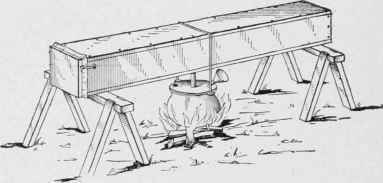
Steam bending is a technique used on woods in order for them to change shape. During the process strips of wood/timber are steam heated using a steam box.  A steam box is a long sealed container which is where all of the steam bending process takes place. Then the heat and mositure makes the wood more flexible which allows the timbers shape to be changed. However during the process the shape has to be held by a mould so that is doesn't have chance to change back to its original shape.


Steam bending is relatively cheap, effective and quick however there is a disadvantage that the wood can only bend to a certain degree. Which can be a pain depending on the purpose that you want to use the wood for.


This is a image showing a steam box

 
This is showing a steam bending jig

Monday, November 11, 2013

Manufactured Boards Notes

Hardboard: is a high-density wood fibreboard and a standard material used in furniture making and in the carpentry industry. The production process results in one very smooth side and a rougher side due to the way that it is manufactured. It is a extremely dense fibreboard. It is manufactured and sold at a thickness of 3mm.

Plywood: is a manufactured board that has properties including increased stability, high impact resistance, dimensional stability, high strength to weight ratio,  chemical resistance. Plywood is generally known as an assemblage of wood veneers bonded together to produce a flat sheet. Which is machined to a thickness of 6mm and is sold at that thickness.

Blockboard:is made up of a core of softwood strips that are extremely thin. These strips may be up to about 25mm wide however they are normally . The strips are placed edge to edge and sandwiched between veneers of hardwood. The sandwich is then glued under high pressure. In order to compress it and make sure that no water enters any gaps that are left. It is sold at a thickness of 18mm and this is the thickness that it is machined to this thickness initally aswell.

Chipboard:is made by gluing together wood particles with an adhesive, under heat and pressure makes chipboard. This creates a rigid board with a relatively smooth surface. Chipboard is available in a number of densities: -normal, medium and high-density. Is sold at a thickness of 18mm.

Medium-Density Fibreboard (MDF)- is a reconstituted wood panel product. It is a dry-processed fibreboard manufactured from wood fibres, as opposed to veneers or particles, and is denser than plywood and particleboard. MDF has an even density throughout and is smooth on both sides.

Thursday, November 7, 2013

Timber & Wood drying methods Notes


Air-Drying Timber -This is a method of drying timber by exposing it to natural conditions.  As such
there is no control over drying rate as this will be determined by the weather conditions , which will vary considerably throughout the year. The average time for timber to dry using this method is 5 weeks.


Kiln-Drying Timber -This is a method of using heat via steam that is involved through a tube to reduce the moisture content of the timber by using heat to heat it so that the water evaporates from the wood, some companys have also tryed reducing atsmospheric pressure in order to speed up this process.

Thursday, October 3, 2013

Uses of Thermoplastics and their properties


Uses of Plastics and there properties

ABS - Acrlonite butadiene styrene is used for the manufacture of Lego because it has to be strong, durable, impact resistant and also cheap to manufacture due to the fact that it is used by children.


CA - Cellulose Acetate- is mainly used for packaging, handles and toys as it is used because it is tough and strong.


Nylon – Polyamide- It’s main properties are
toughness, that its hard wearing, and has a good resistance to chemicals and machines. It is used for Bearings, gear wheels, casings for power tools,  hinges for small cupboards, curtain rail fittings and clothing.


PMMA – Acrylic – Its main properties are
that its Stiff, hard , durable, good electrical insulator, therefore it is used for Signs, covers of storage boxes, aircraft canopies and windows


PP- Polypropylene- It’s main properties are that it is
Light, hard, tough, and has a good resistance to chemicals. Therefore it is used for Medical equipment, containers and hinges.


PS- Polystyrene- It’s main properties are that it is light, stiff brittle and also got a good strength-weight ratio. It is used for packaging and also some disposable cups.


LDPE-
Tough, good resistance to chemicals, flexible and is used for Packaging, especially bottles and also toys.

HDPE- Polyethylene- It’s main properties are that its hard stiff and easily can be made sterile so its used for plastic bottles and containers.


PVC- Polyvinylchloride- It’s main properties are that its durable, cheap and is a good fire resistant. Its main uses are for water pipes, tubing and hoses.


PET- Polyethylene Terepheluate- It’s main properties are that its fully recyclable and sustainable and they also use it because of its high strength – weight ratio and its mainly used for drinks bottles. It’s made via blow moulding as it’s quick, accurate and cost effective.


PC-Polycarbonate- Its main properties are that its strong waterproof and durable and is used for honeycomb sheets.

HIPS- High Impact Polystyrene – Its main properties are that its durable, rugged and also is wear & water resistant and is mainly used for packaging.